 Inkoders
Silicon in Wall Street? How AI Models Are Utilized by Multi-Billion-Dollar Companies to Invest, and Why It May Backfire One Day.
Quantitative and algorithmic models now move trillion-dollar transactions in milliseconds, reshaping the world of commerce and trade. Understand how and why Wall Street migrated to supercomputers, and the systemic risks that poses within the digital finance system.

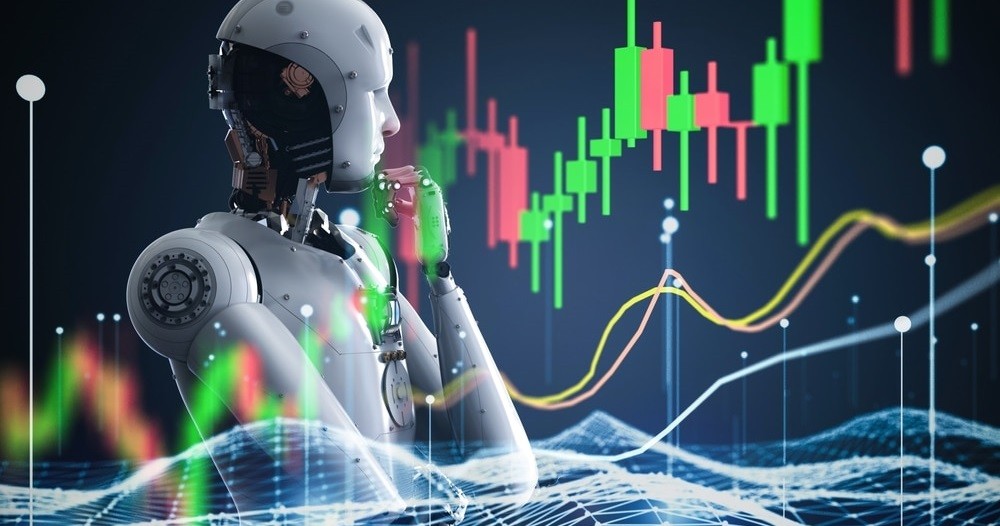
When you think of trade, do you picture an image of the bustling, hectic scenes of Wall Street in New York City? The classic spectacle of traders shouting numbers, investors sprinting to get the best deals, and analysts jotting down each and every price off the big screen has all become the past. The epitome of capitalism has transformed into silent, motionless server farms, as more and more global enterprises are marching towards employing artificial intelligence to generate their capital.
But does this transformation truly boost efficiency, or does it build fragility to the companies' treasury?
Investment banks and hedge funds no longer rely on human intuition to navigate global markets; instead, they deploy advanced machine learning models due to their super-human speed. Advanced code performs high-frequency trading (HFT) – a subset of algorithmic trading that uses complex algorithms to execute massive volumes of micro-transactions in microseconds. This permits them to capture, and take advantage, of the fractional discrepancies across exchanges before human eyes can even process the price movement, building up marginal profits that are fortunes to a normal person.
Advanced algorithmic and large language models (LLM) can also operate on a much more substantial scale compared to humans. Trading firms can deploy massive enterprise GPU clusters to ingest and analyze millions of data points simultaneously across different global markets, from corporate transcripts to live speeches. This scale provides an unprecedented comparative advantage to human analysts as it ensures a vast array of factors, whether big or small, are taken into consideration and analyzed before a transaction is made.
These advantages, paired with the emotionless execution by purely rational data models, engrave artificial intelligence as a widespread tool to cultivate the breeding ground for financial capital. However, tying multi-trillion-dollar portfolios to autonomous algorithms introduces profound systemic vulnerabilities, vulnerabilities that may perpetually prevent the firm from ever recovering.
Complete or virtually complete automation when investing produces a vulnerable threat – herd behavior. Because AI models often use similar, if not the exact same historical datasets, synchronized mass behavior may instantaneously occur when the market experiences incremental changes, as billions worth of capital are all poured into similar assets. This causes amplified market shocks and drops, leading to violent liquidity crunches and stock depreciation within milliseconds, before any human can react and intervene.
AI trading also poses another common problem across models: the black box problem. Unlike traditional software where a programmer can trace every line of logic, advanced neural networks often reach complex trading decisions through opaque internal pathways. Therefore, their creators cannot trace or understand the exact internal steps, logic, or calculations between each trade, which may prove fatal when bugged transactions cost billions worth of capital.
Ultimately, silicon in Wall Street is not a foolproof method of breeding money for massive financial situations; rather it serves as an amplifier for the substantial stakes of a company’s treasury. Its superhuman speed may have transformed the way of the trader, but without sufficient circuit breakers, automation in trading will remain a sharp, almost lethal double-edged sword.
About the author
Director of Treasury & Finance, Inkoders Hong Kong
We live in a limitless world, defined by continuous evolution and transformation. From advanced autonomous capital to everyday mobile phones, technology underpins our daily lives. Distance no longer requires time to overcome, for the internet connects every individual within the edges of this world. However, underneath, these advancements are made possible by countless cornerstones of fundamental knowledge, passed from one generation to another. This is how humans improve, and it is also the reason I joined Inkoders. Through competitions involving coding robots or designing FinTech software, I interact with technology all the time, learning more as I go and accumulating marginal gains. And every, single time, I become astonished by the new ideas, concepts and frameworks designed by my competitors, which fuels my drive to improve and do better. Technology requires knowledge. Like education expert Michael Fullan once stated, “Pedagogy is the driver, technology is the accelerator”; the one behind the steering wheel of these mind-blowing technical achievements is the core foundational literacy the history of humanity had put together. This foundational literacy must also be communicated efficiently and eternally, as technology falls apart without the essential pillars of education. Artificial intelligence will inevitably revolutionise the methods of learning, but we mustn’t let it oversteer and replace the creativity and passion of humans in this physical world. Therefore, I’ll always make sure I balance my online world with hobbies that utilize tangible tools. Whether it is playing a football match, solving a math problem with a pen and paper or writing in my diary, I’ll always enjoy crafting on a fresh canvas, one that isn’t bounded by pixels. Being part of Inkoders gives me the honour to blend the concept of technological literacy and foundational literacy together for the aspiring innovators who will build the future. Our future.
Profile & more perspectives →More perspectives

The Future of Effortless Presentations: Gamma
Stop wasting hours fighting with rigid slide layouts; within 30 seconds and a simple text prompt, your ideas are transformed into a stunning, presentation-ready layout by Gamma.
By Hilary Chong Hiu Lam18 Nov 20262 min read

Has AI Circumvented Copyright Law?
Curtailing Creativity and Copyright in the Age of AI
By Evelyn Chan Tsz Huen16 Nov 20263 min read

Unlocking the Grid: The Science Behind QR Codes
From manufacturing floors to restaurant tables, discover how QR codes leverage clever mathematical patterns to bridge the physical and digital divide.
By Denise Tsoi Man Hei14 Nov 20264 min read