 Inkoders
Has AI Circumvented Copyright Law?
Curtailing Creativity and Copyright in the Age of AI

Director of Curriculum & Institutional Affairs, Inkoders Hong Kong
16 Nov 2026 · 3 min read
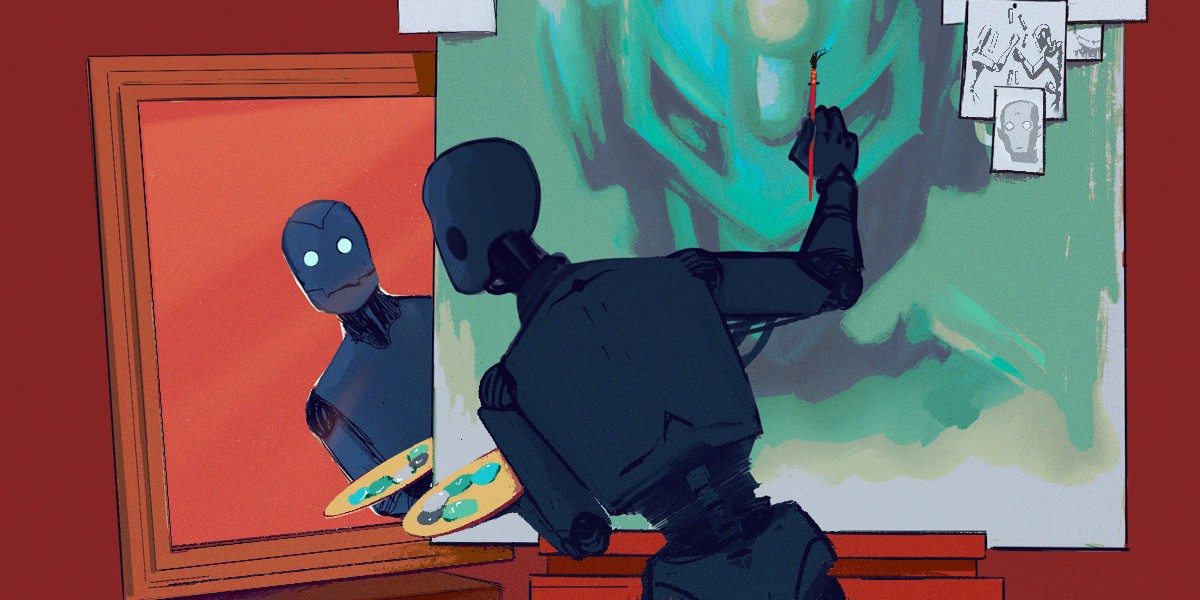
In July 2026, a federal judge in San Francisco approved an AI company Anthropic's landmark $1.5 billion settlement of a lawsuit filed by a group of authors who accused it of misusing their books to train its AI chatbot Claude. The case is the first of a couple of dozen amidst rising tensions between novelists and major tech corporations regarding the lawful use of their creative output.
The perennial principle of copyright law has always been centered around maintaining the creator's right to profit off of their blood, sweat, and tears while balancing precariously the right of the public to access and build upon culture and knowledge. But what happens when the newest wave of technology -- promising to revolutionize the digital age -- erodes the very principles we considered the backbone of human creativity?
Generative AI is a unique stakeholder, both consumer and producer at two different ends of the creative pipeline. On one hand, it consumes ravenously, as AI companies scrape millions of human-authored works from the web, feeding it into a large database for pattern recognition we call the LLM (Large Language Model). On the other hand, AI assimilates what it has learnt from thousands of webpages and countless human input, reproducing an amalgamation of information suited to the user's request upon their whims.
Creators and unions argue that using their work without asking permission or paying creators under normal circumstances devalues human cognitive thinking, reducing the product of their creativity to infinitesimal code for "learning" amid a sea of human output. Yet from a legal lens, large tech corporations often argue that training AI models on copyrighted data falls under fair use in the United States and in certain international jurisdictions. AI is acquiring knowledge, they say defensively, heavily glorifying the "transformativeness" aspect of the way the LLM works. The eventual input of human work into the AI model adds new meaning and message, completely contorting the purpose of the original work thus qualifying as fair use from a commercial standpoint.
In the case of Anthropic, although the court nudged towards the legitimacy of AI training models to acquire text for learning as fair use, it ultimately bore the brunt of the lawsuit due to the unauthorized storage of millions of books from shadow libraries. But the question remains: does training AI have the right to consume lawfully accessed books in broader industry litigation context?
About the author
Director of Curriculum & Institutional Affairs, Inkoders Hong Kong
Technology has become a complex language left for us to decode, forged from the rapid evolution of human civilization. Developing fluency in this new tongue is essential for future generations to navigate a world dominated by change. But as we immerse ourselves in algorithms and interfaces dominating, it is imperative that we retain the foundational skills of communication, critical thinking, and structured thought more than ever. And that is precisely what propelled me to join Inkoders, to empower future generations by building digital literacy. Joining Inkoders as the Director of Curriculum Affairs allows me to fuse my passion for language with technological advancement. I am an avid debater and speaker in public policy and international relations, as well as a tutor for the minds of tomorrow. I have always found the beauty in how words can be yielded as weapons of logic, how words can be painted for vivid emotions, and how words can bridge the gap between different minds. Regardless of how efficient any software can be, the core purpose of technology has always been rooted in helping humanity advance. Knowing we cannot be dependent on these tools is to not only honor generations of the written word, but to foster our independence, cognitive ability, and self-sufficiency.
Profile & more perspectives →More perspectives

Unlocking the Grid: The Science Behind QR Codes
From manufacturing floors to restaurant tables, discover how QR codes leverage clever mathematical patterns to bridge the physical and digital divide.
By Denise Tsoi Man Hei14 Nov 20264 min read

To make cramming easier — RemNote
A personal AI tutor, file organisation system, note-taking engine and flashcards all in one place.
By Christie Leung Yan Ching11 Nov 20263 min read
Money Can Buy Happiness?? A Deep Dive Into The Psychology of Money
Low earnings don't break a person—unrestrained appetite does. Read through the life of Ronald James Read, a testament to how patience can elevate a simple janitor into a millionaire philanthropist.
By Chace Chan Hei Shun10 Nov 20263 min read