 Inkoders
健康旦: When Health Advice Goes Wrong
A cancer patient spends HKD 2.5 million on injections in Japan to cure early-stage cancer, only to get stage 4A cancer. Another spends over HKD 1 million and comes home to die. Who is responsible?
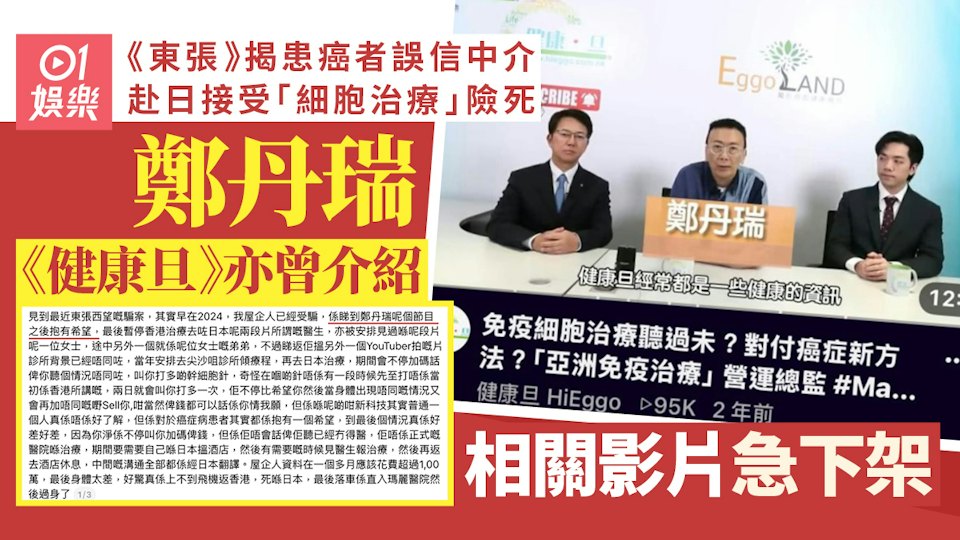
Recently, a Hong Kong health channel has been advertising a Japanese "immune cell therapy", costing patients millions of dollars and even their lives.
The 健康旦 Controversy revolves around the promotion of an "immune cell therapy" in Japan in a video posted in Hong Kong's YouTube health channel run by the veteran entertainer Cheng Dan-shui. According to a TVB expose, one patient spent HKD 2.5 million and progressed from early-stage to stage 4A cancer, and another family member spent over HKD 1 million before dying shortly after coming back to Hong Kong.
In one case, a man was convinced that severe nosebleeds indicated "dead cancer cells being expelled" thus putting off his return to regular treatments till he became critically ill. The other family’s member supposedly abandoned his medical treatment in Hong Kong after watching the 健康旦 video, stayed at a hotel instead of a hospital in Japan, was wholly dependent on the middleman for interpretation and was coerced into paying more as his condition deteriorated, resulting in his death in Queen Mary Hospital.
From a legal standpoint, there is a lot of fragmentation. There may be some legal action against the intermediary for engaging in unregistered practice, but since this has taken place in Japan, the ordinances from Hong Kong cannot extend their reach in this case. The channel and Cheng Dan-shui can be brought to book under the Undesirable Medical Advertisements Ordinance where advertisements that are likely to induce individuals to resort to treatment of cancer using certain medications are prohibited. There might also be legal action under the Trade Descriptions Ordinance for making false statements to the Hong Kong consumers.
About the author
Editorial & Media Officer
I’ve always believed that the pen is mightier than the gavel. Law and media share a common foundation: the power of words to shape reality. A well-constructed argument can change a verdict; a well-told story can change a mind. This is what drew me to both fields—the understanding that language is not just a tool for communication, but an instrument of influence, justice, and transformation. My journey has been shaped by years of competitive debate, where I've had the privilege of testing my ideas on some of the most challenging stages. From winning at the Asia Schools Open (ASNAP) to the Hong Kong Parliamentary Debating Society (HKPDS) and the Sing Tao Inter-School Debating Competition, I've learned to dissect arguments, anticipate counterpoints, and speak with precision under pressure. But debate was never just about the trophies—it was about understanding. Understanding different perspectives, understanding the weight of words, and understanding that the strongest case is built not on volume, but on clarity and conviction. As our world becomes increasingly digital, I've come to see a striking parallel between law and technology. Both are systems of rules—one governing society, the other governing information. Both require interpretation, critical thinking, and a commitment to fairness. And both demand that we ask fundamental questions: Who has access? Who holds power? Whose voices are heard, and whose are silenced? These are legal questions, but they are also digital literacy questions. In an age of algorithms and artificial intelligence, the ability to navigate, evaluate, and create digital content is no longer optional—it is a right, and a responsibility. This is why I joined Inkoders. To bridge the gap between the digital and the human, the technical and the timeless. To advocate for a future where technological advancement does not outpace our ethical and critical capacities. To write the story of the future with the same care and integrity that the past deserves. And to remind ourselves that behind every algorithm is a person, and behind every person is a story worth telling.
Profile & more perspectives →