Inkoders
MAN’S SEARCH FOR MEANING
"He who has a why to live for can bear almost any how."

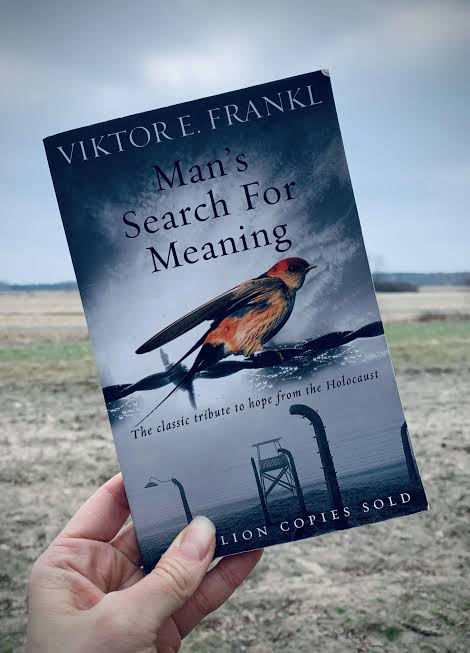
Written by psychiatrist and philosopher Viktor Frankl after imprisonment in Nazi concentration camps during World War II, Man’s Search for Meaning is a book that dives into Viktor’s personal memoirs and existentialism. Throughout his texts, he describes the brutal realities of camp life, and how prisoners coped mentally, while also introducing his therapeutic approach which revolved around the idea that we as humans are driven not by pleasure, but by purpose. He highlights two types of people within the camps and how they tend to meet their fate; the first type are the people who gave up on life - they already told themselves that there was no escape from the SS guards (Hitler's army guarding the prisoners in the camps), and death was inevitable. The second type are the people who still retain hope - they’re the ones constantly trying to find a reason to endure, to return to their normal lives. Frankl states that the second type of people were least prone to die of widespread diseases that spread around the camp, and that statistically speaking they were the ones that would last the longest, purely because of willpower.
This short book remains one of the most powerful regurgitations of human resilience ever written. Frankl constantly links back his experiences to philosophical concepts, drawing most of his ideas mainly from Friedrich Nietzsche’s reflections on suffering and human willpower to live. As Nietzsche famously wrote, “He who has a why to live for can bear almost any how”. Frankl takes this principle and explains throughout his book that many search for how to find meaning, and in context of his situation in the concentration camps, how to retain morale in such a hopeless position. He states that morale isn’t maintained by constantly searching for a reason to survive; rather, Frankl characterizes purpose as something that is ensued, not pursued. Just as success is merely a byproduct of dedication rather than something to be chased directly, true purpose emerges when one commits to a cause, loved one, or a sense of responsibility bigger than said individual. He further emphasizes that there is no perfect, one-size-fits-all model to live your life - just like in a chess game, the best move completely depends on the situation and the individual on the opposite side of the board. Your purpose is exclusive to you alone - your next best move depends on you alone.
Frankl’s perspective allows us to review our choices and challenges. He tells us that “everything can be taken from a man but one thing: the last of human freedoms - to choose one’s attitude”. He backs this statement by giving an example of one of his patients in the concentration camp, in which said patient lost his wife and is mourning her death. Instead of providing direct comfort, Frankl asks the patient how his wife would feel if it was him that died instead, to which the patient responded “For her this would have been terrible; how would she have suffered!” Frankl then pointed out that said patient's wife had been spared from such suffering - the patient had paid the price of surviving and now mourns her instead of the other way around. Looking at the situation in such a perspective allows us to see that there isn’t much we can do about external factors that affect our life, and like Frankl states, “when we are no longer able to change a situation, we are challenged to change ourselves”. Instead of looking at a situation negatively, viewing the situation with an opposite lens would let us find meaning even within the worst suffering imaginable. And so Frankl’s philosophy can be summarized in one sentence: finding something to live for and even die for allows for you to discover why you live in the first place. This genuinely forced me to rethink how I treat different shortcomings - I used to get frustrated whenever trivial things occurred, like when I got a test back and my score didn't meet my expectations. However, after reading this book it allowed me to think in another perspective: I didn't do as well in this test because I didn't do sufficient revision, but perhaps this failure prepares me for the future - perhaps failing now allows me to reflect on how I treat my studies, and what attitude I need to use for more important tests.
If you’re looking for a quick read that delivers lasting depth, this book should be at the top of your list. Man’s Search for Meaning provides an alternate perspective to life; it offers practical knowledge on how you can discover your purpose in life, guidance on how to respond to different situations, and clarity about what truly matters in life.
About the author
Partnership & Funding Officer
If critical thought is the very core that drove innovation and progress, why leave most of the world without the proper tools to fully utilize this ability given to every single one of us? Growing up, my father put heavy emphasis on the need to critically analyse every single situation - he told me to anticipate every outcome before making any decision. He also told me that it's immensely rare for people to achieve this level of cerebration, and having this gift would give me an edge over everyone else. Evidently he wanted me to be the few people that has a "higher level of consciousness", but I instead continuously found myself lingering on a different thought: why should this gift be rare? In a world rapidly being reshaped by technology, the capacity to think deeply and understand foundational systems shouldn't be a privilege reserved for a select amount of people that had comparatively better opportunities; it should be a right for everyone to be able to utilize their brain to it's full potential. Nonetheless, as the child to expectant parents, my father would have these philosophical discussions with me every night at the dinner table, and the questions he would ask me were quite unpredictable. I distinctly remember one night he asked me "If artificial intelligence were to become sentient, should we give them fundamental legal rights?" This topic took me through a infinitely arbitrary line of what it actually takes to have rights in the first place, whether or not artificial intelligence fits into these categories, and ultimately the consequences that would follow. These daily discussions sparked my interest for debate, were I found an inherit love for arguing (politely). It was genuinely exciting listening to what other people have to say on a particular issue, especially when that specific issue has two ends that can't be objectively correct. The more I debated, the more I met with people who viewed every situation with a critical lens. These people truly understood how to execute any model effectively and argue with extreme precision - the reason being they already anticipated every outcome and analysed what it would take to reach a specific goal that could either cause the most change or benefit society on the largest scale. And after every single debate, I realised just how much I envy this level of thinking, and how much it would really benefit society if everyone could look through the same lens. World leaders can actually make effective decisions that cause minimal damage, citizens are able to understand how to effectively avoid harm - society would undeniably develop with more optimism and with a faster rate, exactly what a successful civilisation should look like. We already have the blueprints to further advance into this level of development, and all thats left is our execution.
Profile & more perspectives →